Showing posts with label Alice Hoffman. Show all posts

Friday, June 24, 2011

You never know what you'll find in Hoffman's garden

Fans of Alice Hoffman will love her latest novel, "The Red Garden" (January 2011, Crown, $25 hardcover, 270 pp.) The lyrically written book is more like a series of 14 stories centered over a couple of centuries in Blackwell, a small town in the mountains of Massachusetts.

I took out the audiobook version from the Pottstown Public Library to keep me awake for a trip to western PA, and was pleasantly surprised that actress Nancy Travis was voicing the novel. Travis also voiced Hoffman's novel "The Ice Queen" (which I didn't enjoy as much as "The Red Garden." See my review of "The Ice Queen" here)

Though I wasn't pleased with "The Ice Queen," Travis is the perfect choice to read any of Hoffman's books aloud. Her dispassionate yet nuanced reading does justice to Hoffman's prose, in my opinion.

"The Red Garden" starts in 1750 with the founding of Blackwell, Mass., which was originally called Bearsville because of all the bears in the vicinity. Town founder Hallie Brady arrives in the unpopulated woods of the Berkshires, near Hightop Mountain, with her husband and another couple who are seeking land and their fortunes. However, Hallie's husband proves not to be the best navigator, and the group travels in circles around the area. Fall becomes winter and they are forced to set up camp.

With everyone freezing and starving, and no one else taking the initiative, Hallie goes out into the wilderness with her husband's rifle and boots to find food. She brings back small game and - miraculously - bear's milk. Her discovery of a hibernating bear in a cave on the mountain literally saves the settlers. From then on, bears are protected in the tiny village that will become Blackwell.

In pure Hoffman style (that's her pictured at left), the stories of the inhabitants of Blackwell, beginning with Hallie, are fraught with loneliness and longing and sometimes a spot of magic. It seems not many of the characters get "what they truly want." The founding families of Blackwell and their descendants are featured in the vignettes, which range from poignant to sinister.

John Chapman (Johnny Appleseed) and his brother visit town, spreading their seeds for what will become an orchard and a legendary town tree known as the "Tree of Life," the fruit of which sustains the town through one sparse winter. Emily Dickinson and her beloved dog appear in one of the tales.

Blackwell grows from hunter's outpost to typical small town. Many things in town stay the same over the years: The mountain and its caves, the frigid Eel River, and a garden on the original Brady land where the soil stays blood red and anything planted there turns red, too - even green beans and lilacs. Hence the name of the novel.

True to the magical realism that's a signature of Hoffman's previous novels, "The Red Garden" references the inexplicable: Apparitions and legends, a lot of loners (men who turn into bears, women who love them; women who act like bears and the men who love them), cakes with magical powers, spooky creatures. And, of course, there's quite a bit of passion and heat (and the color red), weather anomalies, and even shapeshifting - a woman who's been turned into an eel.

But mostly it's the story of a small town and the folks - some of them extraordinary - who live in it. Through the stories and the years, Hoffman keeps you guessing as to what will come next. Her writing is lush and charged and sensual. "The Red Garden"is never boring.

About the author:

A native of Long Island, Hoffman, 59, earned a BA from Adelphi University, and a Mirrellees Fellowship to the Stanford University Creative Writing Center, which she attended in 1973 and 74, receiving an MA in creative writing. She resides in Boston.

Hoffman wrote her first novel, "Property Of" when she was just 21 and was studying at Stanford. Since then, she has published a 18 novels, two books of short fiction, and eight books for children and young adults. Her works of fiction include "Practical Magic," "Turtle Moon," "Illumination Night," and "Blackbird House."

To learn more about Hoffman and her novels, visit her website.

Saturday, July 17, 2010

Not Alice Hoffman's best

My rating: 1 of 5 stars

I do enjoy Alice Hoffman but this book was kind of all over the place.

A young girl closes off from the world after her mother dies, and as an adult is the victim of a lightning strike that not only causes her temporary physical impairments, but also takes away her ability to see the color red.

Then she hooks up with a guy who's also a lightning strike victim, and their sex life is, well, hot. Literally. And then she helps her brother through a bout of cancer and lives happily ever after.

This novel was disjointed and lacked the lyrical quality and cohesion of some of Hoffman's other works, such as "Turtle Moon" or "Illumination Night."

I checked the audiobook out of the Pottstown Public Library and listened to it in my car on the way to and from central PA last week. Actress Nancy Travis voiced the book, which I thought would be cool, but she speaks with a cadence that can be a little too lulling at 11 p.m. on Route 78 east after a long week. Just sayin'...


Wednesday, October 21, 2009

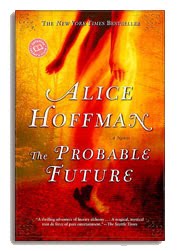
The Probable Future

I'm a fan of Alice Hoffman's books. And while she didn't lose me with "The Probable Future" (Ballantine, 2003, 352 pp. $13.95 paperback), I didn't love it.

True to the author's form, the book draws you in with intricate interweaving plotlines and mystical goings-on.

"The Probable Future" revolves around 13 generations of women in the Sparrow family who have special powers and are native to a small Massachusetts hamlet called Unity. Each of the women bears just one female child who is given her unique gift on her 13th birthday.

The powers range from not being able to feel pain - a "gift" that gets Rebecca Sparrow killed on suspicion of being a witch in the 17th century - to being able to discern a lie, to being able to look at a person and see how they die.
(SPOILER ALERT:) The latter gift is that of one of this novel's main characters, the predictable and annoying teenager Stella Sparrow.

The rebellious Stella's gift gets her in trouble pretty quickly. Or, rather, it gets her philandering father in trouble. During a dinner out to celebrate her 13th birthday, Stella spies the death of a woman seated across the room and begs her father to do something to stop her murder. Relating this tale to the police turns out to be not such a good idea when the women does die in the way his daughter described and now Will is the main suspect.

Stella's mother, estranged from her father and whom she can't hide her hate for, is drawn back to the childhood home she abhors to try to protect Stella, who is forced to move there after her father leaks the story to the big bad press. Every Sparrow woman seems to hate her mother, and Jenny Sparrow (whose gift is being able to dream other peoples' dreams) now must make peace with her own ailing mother, Elinor (who can see peoples' lies).

And so everybody gets drawn back to Unity to figure it all out, and past and present are interwoven - or unraveled as it may be. Sparrows start nearly liking Sparrows again, or re-discovering a tolerance bordering on love. The story of the present and of the past Sparrow women continues until we get to the climax of the story, where it seems every loose end is tidied up in a bow - a little too neatly.

What drags the novel down is that you can see the ending coming from a mile away. You can see the unrequited loves about to become requited and the killers about to get their due.

It was just kinda boring. I wanted to finish the novel just to get it over with rather than to stay with the characters to see what happened to them.

Was it worth reading? Yes.
Was it a great read? No.

Maybe I simply need to stop reading every single book by a favorite author. Beattie, Hoffman, Atwood, Kingsolver, Tartt, for example. They are bound to disappoint sometime.

Saturday, April 4, 2009

'People are haunted because they want to be'


Reviewed: Skylight Confessions, by Alice Hoffman, Little, Brown and Company, 2007, 262 pages.

I've read a lot of Alice Hoffman (prolific author of 18 novels). She has a way of pulling you into stories that touch on the supernatural but are grounded in reality. Skylight Confessions is no exception. It's the story of a couple of generations of New Englanders, none of them quite happy or fulfilled.
The book starts with young Arlie, not even 17, who finds her destiny following her ferry-boat captain father's death. She seduces a young stranger and seals her fate. Soon, Arlie is a mom and wife trapped behind the transparent boundaries of a famous house called 'The Glass Slipper,' an imposing architectural wonder made entirely of glass and with glass ceilings.
That's where the title comes in, and the end of the book reveals some of the secrets/truths of Arlie and her family. Her distant husband John who seems to resent her for seducing him late one foggy night when he got lost on the way to a party and ended up in her bed.
Their son, Sam, becomes a slave to heroin early on. Her daughter, Blanca, never knows a mother's love and eventually physically escapes across the pond but her own happiness remains elusive. Their nanny of sorts, Meridith, brings a fresh twist to the story and another union that seems to come straight from the fates.
Death before one's time, addiction, emotional distance play along with themes of true love, passion, yearning in this engrossing tale.
"People are haunted because they want to be," says Merrie's husband at one point. And it seems to be true. John Moody is haunted no matter where he goes by the spectre of his beautiful young wife, someone he never seemed to fully appreciate. She lingers about in a diaphanous white dress, her signature long red hair loose, her lips silent. She doesn't reprimand and isn't there as a fright. She's just there. Because he can't let her go. Meanwhile, dishes in the house break and crack at random and ash pours off the roof. Birds get trapped inexplicably inside the house. Her presence is felt by everyone there.
It won't take you long to read and may keep you up past your bedtime (but in a good way).
Thanks, Brandie, for loaning this to me even before you read it yourself!

Wednesday, September 3, 2008

Another non-biz book: The River King by Alice Hoffman

The River King The River King by Alice Hoffman


My review


rating: 4 of 5 stars
I've been a fan of Alice Hoffman's mysterious, magical fiction since high school when I read Turtle Moon - borrowed from my sister's library.

The River King didn't disappoint. Hoffman's lyrical prose drew me in to a story about an enchanted Massachusetts boarding school and the suspicious death of an outcast student in the nearby river.

The appearance of watery ghosts, charmed fish and vengeful black cats were not surprising, given Hoffman's penchant for bringing the otherworldly into the everyday.

But also this is a love story, and not just of one couple. An engaged teacher and a lonely cop get together and sparks fly. A beguiling swimmer and a boy from the wrong side of the tracks. Passion triumphs over reason.

A good read. I plowed through the last half of the book in one night. This book missed a fifth star because I was disappointed with how tidily and hastily the book ended. I would've liked to learn more about the lovers, the townsfolk, the dead boy's final resting place.


.